
Growing up, Thanksgiving didn’t always look like the picture-perfect tables you see in magazines. Most years, our special meal came entirely from donations — and I’ll never forget the faces of those kind souls who made sure we had something to eat. Those moments taught me not just gratitude, but humility and the power of community.
With the current government shutdown affecting so many families — especially those relying on food assistance — my heart aches. I know what it feels like to watch shelves get low and wonder what’s next. I know what it’s like to look at random items in the nearly empty pantry and consider how I was going to stretch them into a meal. I also what it’s like to go hungry having had parents who prioritized their habits over our full tummies. However, I also know this: even in the hardest times, God has a way of multiplying the little into much.
If you’re in a place where you’re wondering how you’ll stretch what’s left or make ends meet – I want to share a few thoughts from my heart. None of these tips are quick fixes, but they’re steps that can help you hold onto hope, dignity and a sense of purpose in the middle of uncertainty. If you’re walking through this season unsure of what tomorrow brings, I want to remind you – there is hope. And you aren’t completely helpless; there are steps we can take, both big and small to care for ourselves, our families and our communities. God hasn’t forsaken you.
Use Your Voice - Advocate
One of the most powerful things we can do when we feel powerless is use our voice. Here in America, we have the right (and privilege) to vote on our country’s leadership. Our system isn’t perfect, but your vote – your participation – matters. Vote for leaders who prioritize the family and your ability to provide for your family. Here in WA, we’re about a week out from the general election and you can view the Online Voters’ Guide or the list of Candidates Who Have Filed to make sure you’re fully prepared to cast your vote.
If you’re not sure where to vote, check your local food pantries, churches, or community boards – they often have voter registration info and can help you find your local polling places.
Obviously, this won’t fix things overnight, but it plants seeds for change – and that’s worth something.
While we wait for larger systems to shift, there’s also power in the small things we can do right now – right in our own homes and kitchens.
Grow Something – Even Small Gardens Matter
During World War II, families across the country planted “Victory Gardens” to help sustain their households and communities. It was a reminder that even in scarcity, people could create abundance with their hands from the earth God provided.
With the introduction of food rationing in the U.S., Americans had an even greater incentive to grow their own food in whichever locations they could find. Victory gardens gave people independence by allowing citizens to produce their own food, which reduced pressure on the public food supply during wartime rationing and shortages. I’d venture to say we need to bring back the Victory Gardens! This self-sufficiency would empower families and decrease our dependence on big government for food support.
In 1942, roughly 15 million families planted victory gardens; by 1944, an estimated 20 million victory gardens produced roughly 8 million tons of food – which was the equivalent of more than 40 percent of all fresh fruits and vegetables consumed in the U.S. (Schumm 2014).
Why Grow Your Own Food?
Growing your own food provides independence by increasing self-sufficiency, reducing reliance on fluctuating food prices and uncertain supply chains and gives YOU control over your food source, from variety to safety.
According to a study published by UC Davis, during the early days of the COVID pandemic, people turned to gardening for food access and for stress relief. They found that more green spaces and urban farming opportunities could be helpful in future disasters.
Today, you don’t need acres of land to do the same. A few pots on a balcony, herbs in the kitchen window, or a raised bed in the backyard – it ALL counts. Home gardens can help families stretch their budget during tough times, which we could be on the cusp of today.
I’m not trying to scare anyone and I’m not suggesting you become a “prepper,” by any means. However, it’s wise to consider how we can be better stewards to what God’s given us. Plus, gardening teaches patience, gratitude, and trust that God can bring about new life from dirt.
Simplify Your Table – Home Cooking Is Hope
When money feels tight, simple home cooking can become both a comfort and an act of resistance. You don’t need fancy ingredients to make food that fills the belly and warms the soul.
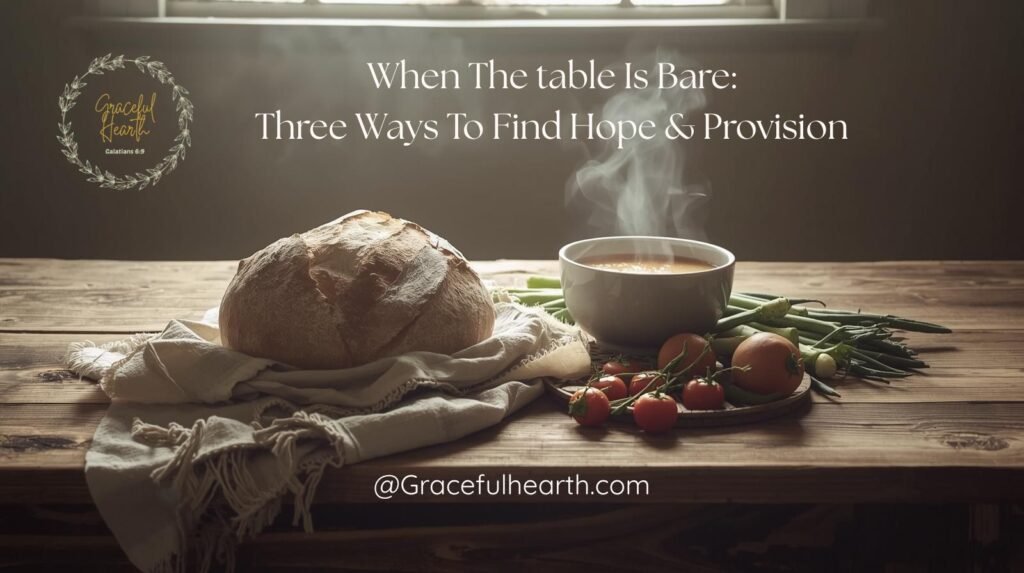
A pot of beans, a loaf of bread, or simmering soup can stretch farther than you might imagine. While these may be humble meals, they carry the same grace and nourishment as any feast.
- Bean & Veggie Soup (use pantry staples)
- Homemade sourdough bread
- Baked apples or pears with cinnamon (no refined sugar, just comfort)
- 4 ingredient granola bars
Food connects us – not just to nourishment, but to creation itself. And sometimes, the best way to feel a sense of control in uncertain times is to literally plant seeds.
Besides simplifying your table, perhaps take a new focus on using every little thing to the fullest. For example, I made pear jam last week and had to core the pears. Rather than throw the cores away, I boiled the cores in water for about 20 minutes to draw out sugars and create ‘pear juice’ to use in pear jelly. Something typically tossed can be repurposed to create abundance. Look online for tips on how to stretch your ingredients further and save a dollar; there are so many YouTube videos!
Growing Your Own Food Is a Counterculture – and Freedom
While I don’t foresee rationing coming back the same way it had been done during WWII, there is a possibility that some families are going to go without certain food support they’ve grown accustomed to. Now, I’m sure someone reading this may completely disagree with the concept of food stamps / SNAP benefits (and that’s completely their right). I’m not pretending that there aren’t people who abuse the system, we know there are and they shouldn’t be receiving handouts. However, the issue of food security is a very real concern in the U.S. and culturally we need to address it because the problem won’t really go away by cutting the funding.
Jesus taught that we should care for the vulnerable which would include widows (and as an extension children) and in doing so it was a way of caring for Him. This doesn’t mean that they waive their ability to provide for themselves, but that we should have compassion to help them succeed. I feel for those single moms (and dads) who work fulltime and may still struggle to provide for their families.
Should it alarm us that there are nearly 4 million Americans on SNAP benefits? Yes, it should alarm us that so many are dependent on a service that can be turned off like a light switch.
Collectively, I think we can all agree that we each should be able to take care of ourselves — and those who cannot (out of no choice of their own) should receive help. It’s scriptural… in 1 Timothy 5:3-16, Paul gives instruction for caring for widows stating they should be honored if truly in need, while also teaching that family members have the first responsibility to care for their own relatives.
Hard seasons can make us feel forgotten, but we have a God who sees. He multiplies loaves and fish, and He still multiples what little we have when we place it in His hands.
I don’t remember every hard season from childhood, but I do remember the kindness of strangers. God provided then, and He still provides now — sometimes through the hands of others, sometimes through the work of our own.
If you’re struggling this season, please know this: you’re not forgotten. You’re seen, loved, and capable of more than you think. The same God who multiplied loaves and fish still multiplies small offerings today. The same God who provided manna in the wilderness hasn’t changed – He’s still faithful today.
I hope that you can take a few of the tips I provided above and put them to use. If you have your own tips – please share with me, I’d love to learn from you!
Scripture: “And God will supply every need of yours according to His riches in glory in Christ Jesus.” Philippians 4:19
Reflection: What’s one small thing you can do this week to bring warmth to someone else’s table?

For such a time as this… a chord is struck in this powerful post. Thank you for sharing, thank you for reframing thoughts of fear into thoughts of gratitude and abundance for God’s grace, and thank you for the practical recipes for families who will value their blessings.
I appreciate your feedback. 🙂 All of these posts are personal to me – but this one took me back to my childhood experiencing food insecurity… that’s deeply emotional for me. Something I mention in my next post — stay tuned. It’s about —– SOIL. Really invigorating stuff. lol